


Pushing the boundaries of exoskeleton technology with Project MARCH
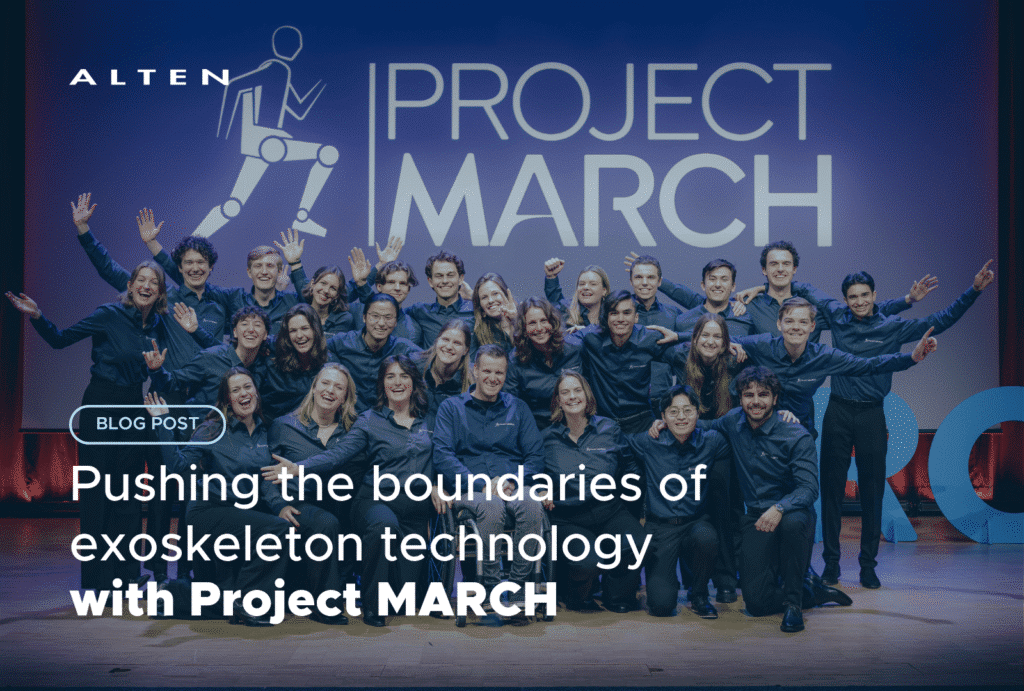
Project MARCH has one clear goal: to improve the quality of life of people with spinal cord injuries by pushing the boundaries of exoskeleton technology. The multidisciplinary project team brings together 26 members from diverse academic backgrounds to design and build a Motor Assisted Robotic Chassis for Humans: an exoskeleton.
“We aim to raise awareness of the daily limitations and challenges that people with spinal cord injuries face.” – Team Project MARCH
Since the start of our partnership in 2022, ALTEN Nederland has supported the student team from the Delft University of Technology with C++ training. By sharing technical expertise, ALTEN helps provide the strong software foundation the students need to turn ambitious ideas into reality.
Breakthrough innovations
Every academic year, Project MARCH develops a completely new exoskeleton, with a distinct technical focus and innovation goal. This year marks a major milestone: for the first time, the team is working towards self-balanced walking without crutches by implementing Generative Predictive Control, an algorithm introduced in 2025. “Within Project MARCH XI, we will develop the first exoskeleton that incorporates this new technology for our walking pattern, enabling our usability tester to walk independently without crutches.”
Beyond walking balance, the team is also focused on improving usability. Their design prioritises making the exoskeleton quick and easy to put on and take off independently. To support this, they’ve developed an innovative hip hinge that allows the leg sections to swing outward while the user is seated on a bench. This eliminates the need to stand during fitting and significantly improves comfort and ease of use.
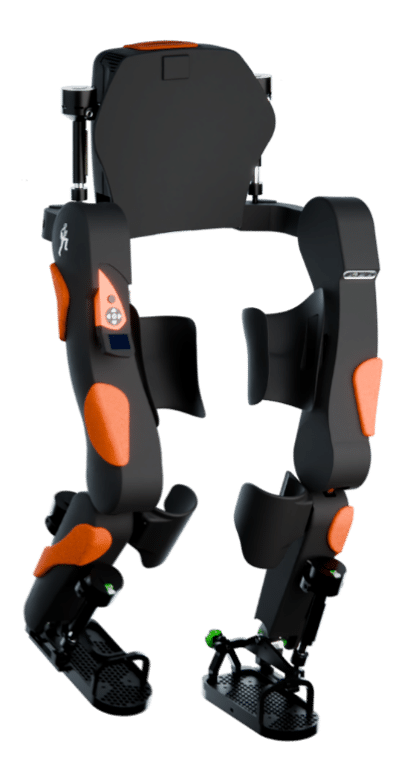
The team has also developed a new Input Device (IPD) that enables hands-free operation. The input device has a newly designed slot within the exoskeleton, enabling the user to use their hands freely in their environment. Next to the IPD, the team continues its work on EEG brain control technology, which allows the user to walk by simply thinking about it. “We have been working on this for the last four years, and this year we have the first working machine learning model.”
From simulation to a physical prototype
Transforming complex concepts into a functioning exoskeleton comes with its challenges. One of the most intricate aspects is translating simulations into a physical exoskeleton. Because the exoskeleton operates in direct interaction with a moving person, achieving stable and balanced walking presents a significant challenge. “During this exciting process, we encounter many setbacks that push us to find new ways to solve them. Often, different departments need to collaborate to overcome a problem.”
ALTEN finds this collaborative mindset of combining expertise from multiple faculties to tackle problems from different perspectives to be one of Project MARCH’s greatest strengths.
Technology to enhance the lives of individuals
The team is also committed to sharing knowledge openly. Their developments and findings are made available through their open-source platforms for anyone to use.
“We want to show that our technology can enhance the lives of individuals with paraplegia through robotic exoskeletons and carry out daily tasks.”
One of the highlights of this academic year was the design presentation where the project team shared their ideas with their partners, friends, and family.
Looking ahead, the reveal presentation at the end of the academic year will be a defining moment. “We are looking forward to Daan, our usability tester, walking self-balanced in our newly developed exoskeleton.”
The next steps
The Project MARCH team is incredibly proud of the steps taken thus far. Although when striving for continuous improvement, what comes next? “We concluded that developing new promising technology is a big challenge when the time is limited, using the Dream Team approach by TU Delft: having a new student team develop a new exoskeleton each year.”
To address this, Project MARCH will move towards a new approach where an exoskeleton will be developed and built in two years, where two consecutive teams (Project MARCH XII and XIII) will be working on the same exoskeleton. “This way, the next big step can be realised.”
A partnership built on knowledge sharing
The collaboration between ALTEN Nederland and Project MARCH is rooted in knowledge exchange. Each year, ALTEN provides C++ training to the software and embedded engineers, helping them gain essential skills at the start of their project.
For many students, C++ is still relatively unfamiliar at the start of the project, even though it is a crucial language for their exoskeleton architecture. Our training, given at the beginning of the academic year, provides the student team with a strong starting point, strengthening their technical capabilities and acting as an opportunity to build on their skills independently.
Beyond technical support, our partnership is characterised by close collaboration and active involvement. “There’s a strong, solid foundation for the collaboration, which makes it very easy for a new team to step in. It’s great to see how committed and engaged ALTEN is as a partner.”
Looking ahead together
Project MARCH continues to push the boundaries of exoskeleton technology, and ALTEN Nederland remains committed to supporting their journey. By continuing to invest in technical training, we will ensure that each new generation of students can build on a strong technical base.
Together, we are not only supporting the engineers of tomorrow but also contributing to innovations that have the potential to transform lives.